
Creativity Isn’t a Talent. It’s a Nervous System Need.
By Donna Marie Marino
Most adults don’t stop creating because they lose interest.
But somewhere along the way, creativity becomes tied to performance.
Being “good at it”.Doing it “correctly”.Making something “worth showing”.
For many people, especially high-functioning adults who spend most of their lives managing responsibilities, solving problems, and pushing through stress, creativity slowly disappears from daily life altogether.
Even when they deeply need an outlet.
At Armonía, we see this often.
People come into therapy mentally exhausted, emotionally overloaded, and disconnected from themselves in ways they can’t always explain.
Many can describe what they’re thinking, but not necessarily what they’re feeling.
Others have spent so long staying productive and composed that they don’t even realize how much tension they’re carrying until they finally slow down.
And lately, that seems to be true for almost everyone.
There’s a level of stress, uncertainty, overstimulation, and emotional fatigue many people are carrying right now that doesn’t always have a clean explanation or solution.
Sometimes the nervous system simply needs somewhere for all of that energy to go.
That’s one of the reasons creative expression matters so much.
Humans were never meant to process life only intellectually.
“Art gives people a way to express things that are difficult to put into words,” says Armonía art therapist Christina Ortiz-King, LMHCA, ATR-P. “A lot of healing happens nonverbally. Sometimes people don’t fully understand what they’re feeling until they start creating.”
Donna Marie Marino, founder of Armonía, felt drawn to creative expression long before becoming a therapist or business owner.
“When I was younger, I could lose hours creating,” Donna says. “I realized early on that when I was deeply engaged in something creative, everything else quieted down. My mind slowed down. Things I was processing emotionally would start making sense without me forcing it.”
That understanding became part of the vision behind Armonía itself.
“When I imagined this space, I always knew I wanted it to include more than traditional talk therapy,” Donna explains. “Healing happens in so many different ways. Through movement. Through stillness. Through creativity. Through connection. Art therapy felt like a natural part of that vision.”
And interestingly, Christina found Armonía before Armonía found her.
She reached out to Donna before any art therapy position had even been advertised.
“It felt aligned immediately,” Donna says. “Her creativity, her warmth, her energy, her pink hair!… It all fit the spirit of the space naturally.”
What makes art therapy different is that the process itself becomes part of the healing.
Not the outcome, the process.
That distinction matters more than people realize.
“A lot of adults get nervous because they think they need to be artistic,” Christina says. “But art therapy really isn’t about making something beautiful. It’s about expression. It’s about movement. It’s about giving emotions somewhere to go.”
That can look very simple.
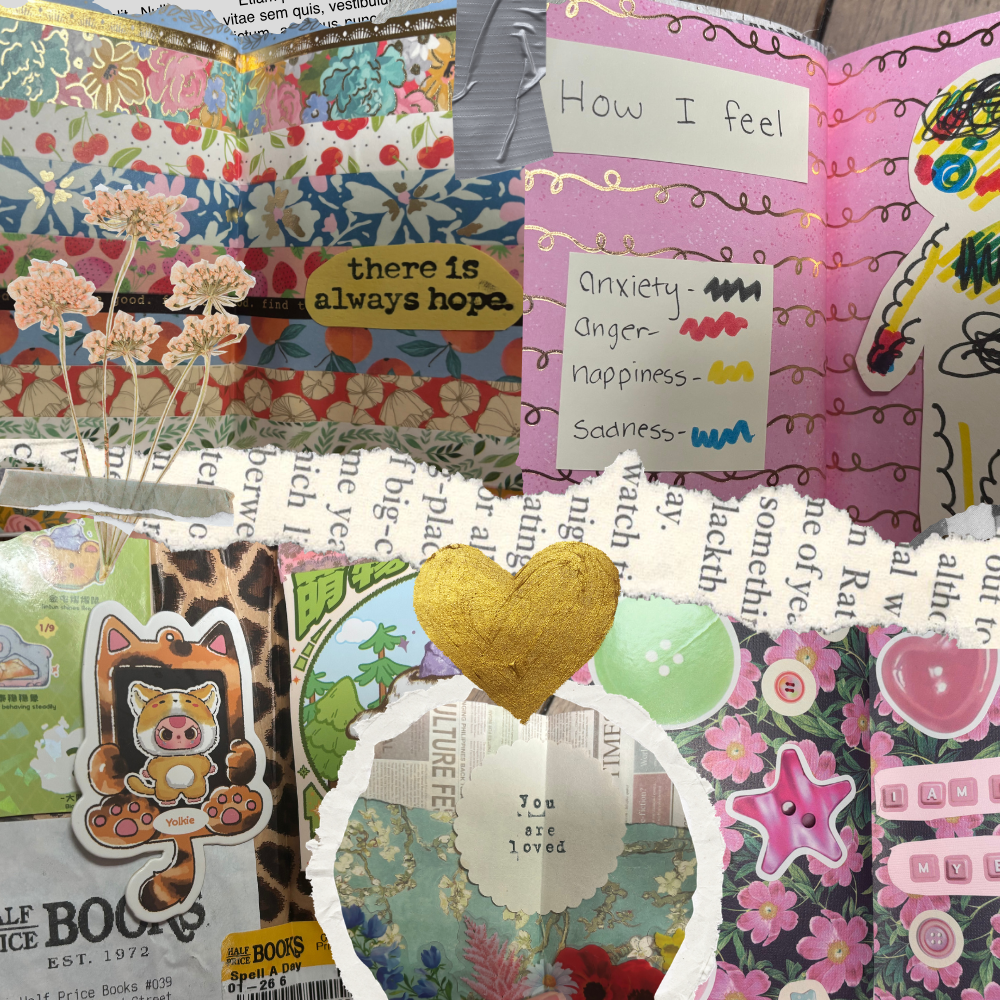
Ripping paper.Layering images.Scribbling aggressively across a page.Cutting shapes out of magazines.Choosing colors instinctively.Gluing pieces down without overthinking them.
Even those small physical actions can help regulate the nervous system.
“Something like tearing paper can actually help release tension or anger physically,” Christina explains. “The sensory experience matters. The movement matters. Sometimes the act of creating itself is what helps.”
That’s part of why creative activities like collage journaling can feel so accessible for people who normally struggle with creative expression.
There’s no intimidating blank canvas.No pressure to draw well.No expectation to make something polished.
Instead, people work with pieces that already exist and begin arranging them intuitively.
Words.Textures.Colors.Images.Fragments that resonate emotionally before they make logical sense.
And often, something unexpected happens in the process.
People slow down.
Their thoughts become quieter.
They stop trying to “figure everything out” for a little while.
For adults who spend most of their lives in their heads, that can feel surprisingly emotional.
Christina sees this especially with people who are overwhelmed, emotionally stuck, grieving, anxious, or struggling to process experiences they can’t fully articulate yet.
“So many people are carrying emotions they haven’t actually had space to feel,” she says. “Art therapy creates that space gently. You don’t have to explain yourself perfectly. You don’t even have to know exactly what’s coming up yet.”
And while creative expression can sometimes feel vulnerable or exposing, activities like collage journaling often feel safer because the process is indirect.
You’re not starting from nothing.
You’re responding.
Collecting.Choosing.Arranging.Noticing.
Sometimes people create pages that feel peaceful.Sometimes messy.Sometimes chaotic.Sometimes unexpectedly honest.
All of it counts as expression.
At its core, art therapy is less about creating art and more about reconnecting with yourself without judgment.
“The people who benefit most are usually the ones who start by saying, ‘I’m not creative,’” Christina says with a laugh. “This work helps people reconnect with parts of themselves they’ve ignored for a long time.”
That’s part of why Armonía is hosting a small-group Collage Journaling Workshop with Christina Ortiz-King on Saturday, June 13, 2026.
The workshop is designed for adults who feel mentally overloaded, emotionally stuck, creatively disconnected, or simply exhausted by the pressure to constantly hold everything together.
Participants will be guided through collage journaling techniques in a supportive, low-pressure environment where the focus is not on artistic skill, but on emotional expression, nervous system regulation, and self-reflection.
No artistic experience is needed.
The workshop will take place at Armonía Life Design in Fishers, Indiana, from 10am–2pm. All materials are provided, and space is intentionally limited to keep the experience personal and supportive.
If you’ve been craving a way to process stress, reconnect with yourself, or simply get out of your head for a little while, this may be a gentle place to begin.
Click here to learn more or reserve your spot for the June 13, 2026 Collage Journaling Workshop, or contact Christina Ortiz-King at christina@armonia-counseling.com with any questions.