Get It Out: Mini Emotional Art Journaling to Help Wrap Your Head Around The World And Your Place In It
By Christina Ortiz-King
At some point, many of us become so afraid of failure that we stop doing anything we’re not already good at. We start placing pressure on ourselves with completely made-up expectations for activities that are supposed to be fun.
We don’t go for a run because we’re “not fast enough.” We don’t paint because we’re “not artistic.” We don’t try the hobby because there’s no way we could ever do it well enough.
And just like that, we end up with no hobbies, no outlets for stress, no real way to relax. Just a lot of overthinking and not a lot of joy.
It’s always too much of this, not enough of that.
When we constantly compare ourselves to others; when a hobby only “counts” if it’s impressive or shareable, we start to suck the joy right out of life. Not every drawing has to be a masterpiece. Not every poem needs an audience. And not every workout needs to be Instagram-worthy.
I work as an art therapist, and one of the first things adults say when they find that out is: “I’m a terrible artist. I could never do that.”
This objection is so common that in grad school, we actually practiced how to respond to it.
Here’s the truth: art isn’t about being “good.” It’s about doing. It’s about feeling.
Art therapy gives people a way to process emotions that feel big, messy, or overwhelming without needing to put them into words. It’s nonverbal, it’s personal, and despite popular belief, it’s not something you have to be good at.
So how do you convince people to try? To believe it’s okay to make mistakes? To create just for the sake of creating?
You don’t convince them, you make it easier.
You make it accessible.
You make it small.
You make it private.
And you make it quick.
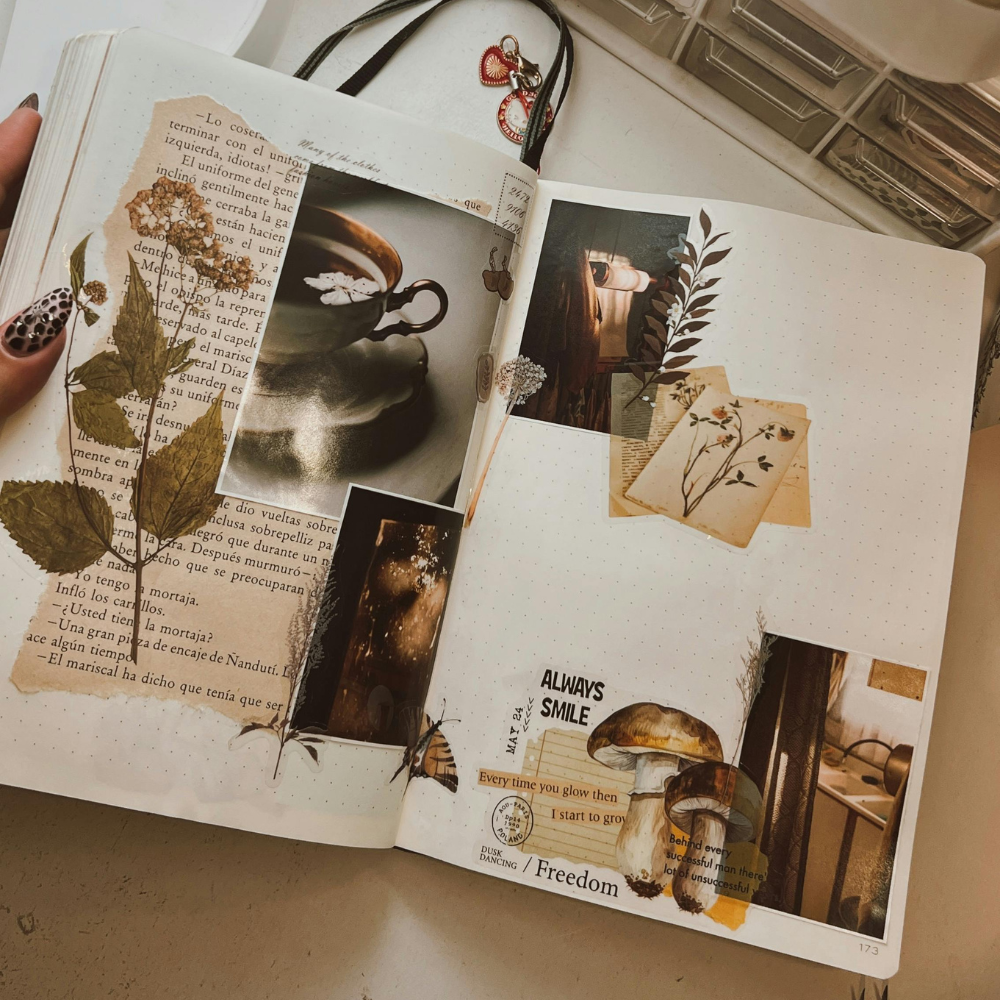
That’s why I love collage journaling.
It’s accessible because you can use just about anything: receipts, napkins, old grocery bags, random scraps you’ve collected without knowing why (we all have that pile).
A glue stick costs a couple of dollars, and a mini sketchbook can last you ages. Sure, you can buy cute scrapbook supplies if that sparks joy (no judgment, I’ve been known to wander the craft aisle a little too long), but you don’t have to.
The mini sketchbook helps because it’s not intimidating. A giant blank canvas can feel like a personal attack. A small page? Much friendlier. Less pressure, more “I can handle this.”
It’s also private. Like a diary, it’s just for you. No audience, no expectations, no need to explain yourself.
And then there’s time. Starting a big art project can feel like signing a contract for the next five hours of your life. A journal spread? Ten minutes. Maybe fifteen if you’re feeling fancy.
So what do you put in it?
Anything.
A page about the weird mood that’s been following you around all week.
A page about something that made you laugh.
A page about that one embarrassing memory from ten years ago that shows up uninvited when you’re trying to fall asleep.
When the goal shifts from “make something good” to “I feel good,” everything changes. You start to enjoy the process because there’s no pressure to perform.
Can you make it pretty if you want to? Of course. Some people genuinely love that part. But the point is to remove the pressure, not replace it with a prettier version.
Some pages are going to be ugly. Honestly, some pages should be. If you’re working through a fight, grief, stress, or something that feels heavy, it probably won’t look like your great aunt's curated scrapbook and that’s kind of the point. Messy, rushed, chaotic pages are still doing their job. Sometimes it is just about getting it out!
Let them be ugly. Let them be honest. Let them exist. Get it out!
We all need outlets, whether we’re “good” at them or not. Art journaling is just one way to let things out, to make space, to breathe a little easier.
So find something that feels good, and let it be imperfect.
And remember what I firmly believe could be art therapy’s official motto:
It’s about the process, not the product.
If you’d like to learn more about working with me, and schedule a complimentary 15-minute consultation, please click here.